밤마다 다리가 편치 않다면 When Nighttime Leg Discomfort Won’t Let You Rest

처음 경험한 건 지난해 50대 중반, 밤 11시쯤 누웠을 때다. 다리가 저리는 것처럼 느껴져 계속 움직이게 되고, 그러다 보니 새벽 2~3시까지 잠을 못 이루곤 했다. 처음엔 피로나 잠버릇인 줄 알았는데, 이게 3주일을 넘게 반복되니 뭔가 다르다는 생각이 들었다. 알고 보니 근육량 감소와 밀접한 신경계 질환이었다. 그 이후로 근력 운동을 꾸준히 하면서 밤에 다리 불편함이 많이 줄어들었다.
잠자리에 누웠는데 다리가 저리고 쑤시거나, 벌레가 기어다니는 듯한 불쾌한 감각에 다리를 계속 움직이게 된다면 한 번쯤 짚어볼 필요가 있다. 이런 증상을 단순한 피로나 잠버릇으로 넘기는 경우가 많은데, 신경계 질환인 하지불안증후군일 수 있고, 최근에는 근육량 감소와도 밀접하게 연관될 수 있다는 연구 결과가 나와 주목을 받고 있다.
If you find yourself lying in bed with legs that ache, tingle, or feel like something is crawling under the skin — an urge that forces you to keep moving them — it may be worth looking into. Many people dismiss these sensations as simple fatigue or a sleeping habit, but they may point to restless legs syndrome (RLS), a neurological condition. Recent research has also suggested a meaningful link between this condition and reduced muscle mass.
하지불안증후군, 어떤 질환인가 What Is Restless Legs Syndrome?

하지불안증후군은 주로 저녁이나 밤 시간대 휴식 중 다리에 불쾌한 이상 감각이 나타나고, 이를 완화하려는 충동에 다리를 계속 움직이게 되는 신경계 질환이다. 분당서울대병원 수면센터 자료에 따르면 철결핍성 빈혈, 신장 질환, 당뇨, 비타민·미네랄 결핍 등 다양한 신체 상태가 증상을 유발할 수 있다고 알려져 있다. 서울아산병원 질환 정보에서는 증상이 지속될 경우 만성 불면과 삶의 질 저하로 이어질 수 있다고 안내하고 있다. 잘 알려져 있지 않아 단순 잠버릇이나 정형외과적 문제로 오해해 제대로 확인받지 못하는 사례도 많다고 한다.
Restless legs syndrome is a neurological disorder characterized by unpleasant sensations in the legs during rest — typically in the evening or at night — accompanied by an irresistible urge to move them. According to the Sleep Center at Seoul National University Bundang Hospital, various physical conditions including iron-deficiency anemia, kidney disease, diabetes, and vitamin or mineral deficiencies are known to be associated with triggering symptoms. Asan Medical Center’s disease information notes that when symptoms persist, they can lead to chronic insomnia and a significant decline in quality of life. Because the condition is not widely recognized, it is often misidentified as a sleeping habit or an orthopedic problem, leaving many cases unaddressed.
근감소증 남성, 위험 2.7배 높다 Sarcopenic Men Face 2.7 Times Higher Risk

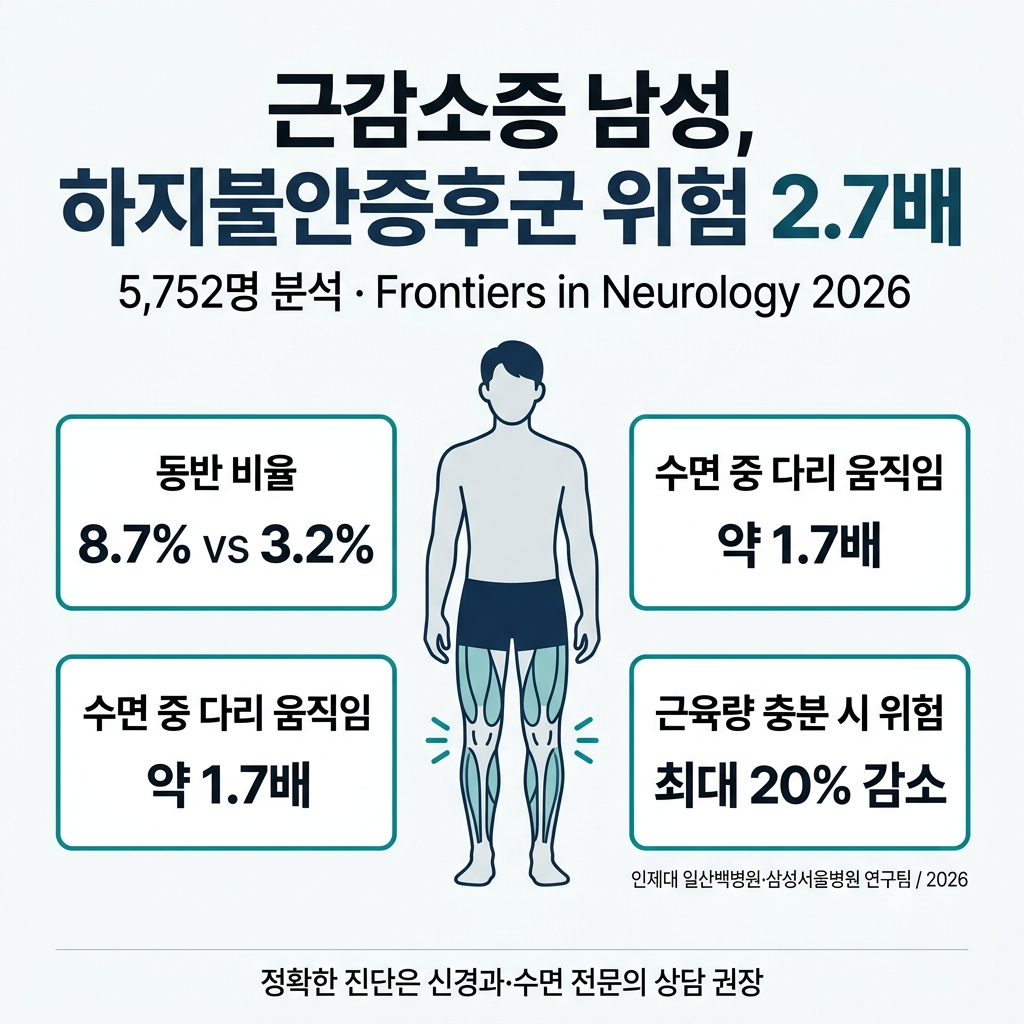
인제대학교 일산백병원 신경과 배희원 교수와 삼성서울병원 신경과 주은연 교수 연구팀은 성인 5,752명을 대상으로 체성분 검사와 수면다원검사 데이터를 함께 분석해 근육량과 하지불안증후군의 연관성을 확인했다. 해당 연구는 신경학 분야 SCI급 국제학술지 ‘프론티어즈 인 뉴롤로지(Frontiers in Neurology)’ 2026년에 게재됐다. 전체 유병률은 여성 6.6%, 남성 2.9%로 여성이 더 높았으나, 근육량과의 연관성은 남성에서만 뚜렷하게 확인됐다. 특히 근감소증이 있는 남성의 하지불안증후군 동반 비율은 8.7%로 정상 남성(3.2%) 대비 약 2.7배 높았으며, 수면 중 다리의 주기적 움직임도 약 1.7배 더 빈번하게 나타났다.
A research team led by Professor Bae Hee-won of the Department of Neurology at Inje University Ilsan Paik Hospital and Professor Joo Eun-yeon of Samsung Medical Center analyzed body composition and polysomnography data from 5,752 adults, confirming a notable association between muscle mass and RLS. The study was published in 2026 in Frontiers in Neurology, an SCI-indexed international journal in the field of neurology. Overall prevalence was higher in women (6.6%) than in men (2.9%), but the association with muscle mass was found to be significant only in men. Notably, men with sarcopenia had an RLS co-occurrence rate of 8.7%, approximately 2.7 times higher than that of men without sarcopenia (3.2%). Periodic limb movements during sleep were also approximately 1.7 times more frequent in this group.
연구팀이 제시한 기전 3가지 3 Key Mechanisms Proposed by the Research Team

연구팀은 근육 감소가 하지불안증후군 발생에 영향을 미치는 주요 경로로 세 가지를 제시했다. 첫 번째는 말초 조직으로의 산소 전달 능력 저하, 두 번째는 근육 유래 항염 물질인 마이오카인 감소, 세 번째는 산화 스트레스 증가에 따른 도파민 신경계 변화 가능성이다. 남성에서는 수면 부족이 테스토스테론 감소와 근육 손실로 이어지고, 이것이 다시 수면 질 저하와 연결되는 악순환 구조, 즉 ‘근육-수면-신경 기능’이 서로 영향을 주고받는 복합적인 생리 구조와 연관될 가능성도 있다고 연구팀은 밝혔다.
The research team identified three primary pathways through which muscle loss may contribute to RLS development. The first is a decline in the capacity to deliver oxygen to peripheral tissues. The second is a reduction in myokines, anti-inflammatory substances produced by muscle. The third is the possibility of changes in the dopaminergic nervous system resulting from increased oxidative stress. The team also noted that in men, sleep deprivation may lead to decreased testosterone and subsequent muscle loss, which in turn further degrades sleep quality — suggesting a cyclical structure in which muscle condition, sleep, and neurological function are mutually reinforcing.
근육량 지표별 위험도 차이 Risk Differences Across Muscle Mass Indicators

다양한 근육량 지표에서도 하지불안증후군 위험과의 연관성은 일관되게 확인됐다. 키 대비 근육량 비율을 나타내는 골격근지수(SMI)가 낮을수록 위험은 6.5% 증가했고, 근육·뼈·수분 등을 포함한 제지방량지수(FFMI)가 낮아도 위험도는 2.5% 상승하는 경향을 보였다. 반대로 근육량이 충분한 남성은 질환 발생 위험이 유의미하게 낮은 경향을 보였으며, 골격근지수가 높을 경우 위험이 최대 20% 낮았다. 같은 체중이라도 근육 비율이 낮고 체지방 비율이 높으면 위험이 높아지는 경향이 있다는 점도 이번 연구에서 확인된 내용이다.
The association between RLS risk and muscle mass was consistently observed across multiple indicators. Lower skeletal muscle index (SMI), which reflects muscle mass relative to height, was associated with a 6.5% increase in RLS risk. A lower fat-free mass index (FFMI), which accounts for muscle, bone, and fluid mass, was linked to a 2.5% rise in risk. Conversely, men with sufficient muscle mass showed a meaningfully lower tendency toward developing the condition, with those having a high SMI showing up to 20% lower risk. The research also confirmed that even at the same body weight, a lower muscle-to-fat ratio was associated with higher risk.
지금부터 챙길 수 있는 것들 What Can Be Done Starting Now
배희원 교수는 “특히 남성에서는 근육량 감소가 중요한 위험 요인으로 작용할 가능성이 있는 만큼, 근력 운동과 유산소 운동을 병행하는 적극적인 관리가 도움이 될 수 있다”고 밝혔다. 대한의사협회지 2024년 자료에서는 복합 운동, 즉 유산소와 저항 운동을 함께 진행하는 방식이 근감소증 관리 연구에서 가장 많이 시도되는 방법으로 언급되고 있다. 밤에 다리 증상이 자주 나타나고 수면에 지장이 생긴다면 단순 피로로 미루기보다 신경과 또는 수면 전문의 진료를 받아보길 권장한다.
이 글은 일반적인 건강 정보 공유 목적으로 작성됐다. 정확한 진단과 처방은 가까운 의료기관 또는 신경과·수면 전문의 상담을 통해 확인하길 바란다.
여러분은 비슷한 증상을 경험한 적 있으신가요? 근육 관리와 수면 질에 관심 있는 분들의 댓글도 환영한다.
Professor Bae noted that “in men in particular, reduced muscle mass may act as a significant risk factor, and actively managing this through a combination of resistance and aerobic exercise may be beneficial.” A 2024 review published in the Journal of the Korean Medical Association cited combined exercise — integrating both aerobic and resistance training — as the most commonly studied approach in sarcopenia management research. If leg discomfort at night is frequent and disrupting sleep, it is advisable to consult a neurologist or sleep specialist rather than attributing the symptoms to fatigue alone.
This article is intended for general health information purposes only. For accurate diagnosis and treatment, please consult a qualified medical professional or specialist at a healthcare facility near you.
Have you experienced similar symptoms? Feel free to share your thoughts or experiences in the comments.
#하지불안증후군 #근감소증 #수면장애 #다리저림 #근육량감소 #수면질저하 #남성건강 #근력운동 #신경과 #수면건강
#RestlessLegsSyndrome #Sarcopenia #SleepDisorder #LegDiscomfort #MuscleLoss #SleepQuality #MensHealth #StrengthTraining #Neurology #SleepHealth